Patti Anklam
  • Home
  • About
  • Consulting
  • Writing
  • Net Work
  • NetWorkShops
  • Blog
  • Contact

language

Archive

December 4, 2009 by Patti

Fernando Flores, Speech Acts, and Networks

One of the most powerful learning experiences in my time at Digital Equipment included immersion in a set of practices for effective communication. What I and my colleagues called “Contextual Management” was derived from philosophies articulated and propagated by Fernando Flores. At the heart of these philosophies are speech acts, a linguistic concept identified by John Searle and refined by Flores into a communication structure for effective management. These same speech acts are at the foundation of Landmark Education.


To me, the concept of speech acts is about being mindful that our language — what we say and how we say it — is creating the world we live in, as we live it. If we can identify — just think — about how we are being heard and the potential results, we can work more effectively. Speech acts include:
  • Declarations: statements about the world as it might be, that create a powerful future, and for which there is no evidence. “The US will put a man on the moon and bring him back before the end of the decade,” famous words from President John Kennedy, are an example. At the time he spoke this, NASA did not have the technology to accomplish this, but by saying it, Kennedy created the future in which this happened.
  • Requests, or offers: a request can also create the future, in that it is possible to ask someone to do something that they do not know how to do. But in daily work life, we make requests all the time. We do not often enough, however, make well-formed requests, which are in the form, “will you please do x-action BY time-y?” The specificity of x-action and time-y make it clear that the requestor is asking for something that is important.
  • Promises: promises are commitments to do perform specific actions by specific times. Obviously, a goal of a request is to acceptance (a promise) to respond to the request, in its specificity, by the designated time. (One may also respond to a request by negotiating the deliverable, the time that is is requested for, and so on; or may decline it, respectfully.)
From these, and other speech act building blocks, a number of communication patterns unfold. I’d like to take some of these up in future posts, but my inspiration for starting this thread is a terrific article about Fernando Flores that has just come out in strategy+business, “Fernando Flores Wants to Make You an Offer.”

In the article, Lawrence Fisher provides a biography of Flores, whose life represents a journey from a Chilean prison to work at Stanford with Terry Winograd, developing a successful consulting business, and ultimately a return to Chile as a statesman. The book he co-authored with Winograd, Understanding Computers and Cognition, describes how software programs could be used to enable more productive relationships in the workplace — using the speech acts as a basis for communication.

It’s a rich article (you will learn more about speech acts) that comes at a time that Flores is shifting into a new phase of his life and work, returning to business consulting to bring his perspective into how we work in networks. His concern is that:

“How do you educate people for the future world, in which an important part of activity is going to be networks?” he asks. “In my opinion, we human beings are not prepared at all for the explosion of new practices the Internet will produce. Education is going to be in networks and it will not be about knowledge. It will be about being successful in relationships, about how to make offers, how to build trust, how to cultivate prudence and emotional resilience.”

I’m excited about the possibilities in net work thinking opened up by the questions Flores is raising. The social web is opening up entirely new ways of communicating — both means and modes — and my head is already spinning at the thought of integrating these past and new ideas into my work.

TwitterFacebookGoogle BookmarksDiigoStumbleUponTumblrDeliciousShare

Archive

October 27, 2009 by Patti

Brain Talk (1): Emotional Responses

I’m engaged with a local group of colleagues on a series of conversations about the marvelous complexity, flexibility, and mysteries of the brain. Our first conversation was with Deb Gilburg. Deb and her family associates at Gilburg Leadership Institute have done a lot of good thinking about how to talk to executives about how the structure of their brains can color their responses to events and affect their decision-making. Executives also need to be aware that this human system is always at play in the workforce as something to be dealt with.

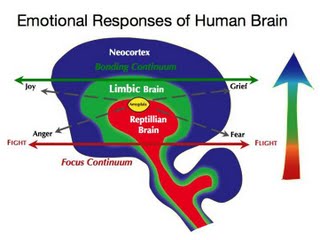
The Gilburgs use the diagram on the right (and the red and green lines) to provide a language for talking about the brain. (My humble apologies in advance to Deb if I’ve misstated any of this. It is a simplification, but I might still have some of it wrong.)

Neocortex: this is what we normally think of as our operative “brain,” and it contains the machinery for hearing, seeing, thinking, creativity, remembering, decision-making, and so on. We didn’t talk about this much, especially as we talked about how the machinations of the other three components control how much of our neocortex is available to us.

Our limbic brain (green) is shared with other mammals. It is where empathy resides, and our ability to do bond with and be influenced by others. Feelings are what bonds us. This is how we connect with others who share our values; the extent to which we share values dictates the extent to which we can “move into” the neocortex to work together. If you haven’t seen Rebecca Saxe’s TED talk about how we read each other’s minds, you should! She uses MRI to identify what happens in our brains when we consider the motives, passions and beliefs. It’s in this part of our brain that we try to make sense of what is going on in other people’s brains.

The amygdala (yellow) is our emotional memory store. This is where our preverbal memories reside (which are sometimes surfaced during psychoanalysis). The amygdala is responsible for our split-second responses to emotionally-charged situations – those times where we don’t think about what we are going to do; we just up and do it. Often, situations our amygdala perceives as threatening can lead us to the “red line” continuum of responses, from flight to fight.

The reptilian brain is where our survival mechanisms exist. Threats activate this portion of our brain – and the amygdala can alter the circulation of blood flow for a split second away from the neocortex (so no time-consuming analysis can be performed) to either the upper or lower torso, depending on the determined response. The loss of blood flow to the neocortex can also happen to a lesser degree during a time of sustained stress, thus leading to more subtle but pervasive “redline” behaviors. So it is perhaps easy to see why we act unreasonably when we are stressed. For executives, this kind of stress can trigger survival-based behaviors (power plays, knowledge hording, peer distrust, etc.) that would be less likely were they not at this stress level.

“If we don’t have a green-line way to process stress & fear, we’ll drop to the red line.”

The value of understanding the brain in this way is that it provides a way to overwrite the blueprint. For an executive, this can mean acknowledging when employees are stressed (on the red line), and creating opportunities for them to bond over shared values (the green line) so that they can move into creative and strategic action.“Having conversations about what we care about and why can reset our brain and help us make better sense of what is going on, and think more strategically and creatively about solutions.”

A wonderful example of this concept is how Paul Levy, President and CEO of Beth Israel Hospital, addressed a serious budget problem. The hospital was in a position in which it would need to lay off many of the lower-waged employees. Levy was reluctant to do that, as he understood how these people contributed to the hospital as well as the importance of the jobs to their lives and families. At an employee meeting, Levy spoke directly to the staff about his concern, saying, “… if we protect these workers, it means the rest of us will have to…give up more of their salary and benefits.” He received a resounding standing ovation, and over the next several days, suggestions for how the hospital could save money. Many of those ideas involved job sharing, reducing hours, and the like. (Full quote, and full story from the Boston Globe: “A head with a Heart.”)

In the language of the brain’s colors above, what Levy did with his employees was move them from the red line to the green line by connecting them to a core set of shared values about the hospital workers and engaging them to participate in coming up with a solution, because he had none. Getting to the green line freed the hospital staff from more primal, red-line reactions to the budget reality and enhanced their capacity to exercise their neocortex— to think and solve problems creatively, and move the work of the hospital forward.


I like the way that Deb related the green line (“bonding continuum”) to the style of a network. Every network has a purpose, and it is in sharing the purpose of the network that bonds people toward action. A great lesson for network builders and weavers.

Next time: Neuroplasticity

TwitterFacebookGoogle BookmarksDiigoStumbleUponTumblrDeliciousShare

Search

Archives

Communities and Networks

Communities and Networks Connection

Publications

Now available from Amazon.com and other online booksellers:

Posts this Month

May 2013
M T W T F S S
« Jan    
 12345
6789101112
13141516171819
20212223242526
2728293031  

Categories

  • adoption
  • blogging
  • brain
  • causes
  • collaboration
  • collective intelligence
  • communities
  • complexity
  • culture
  • definitions
  • e2conf
  • Enterprise 2.0
  • future-of-work
  • generations
  • health
  • innovation
  • KMWorld
  • knowledge management
  • language
  • leadership
  • mindsets
  • net work
  • networks
  • nonprofits
  • ONA
  • people
  • PKM
  • relationship
  • SNA
  • social business
  • social learning
  • social media
  • social network analysis
  • software
  • speech acts
  • trust
  • Uncategorized
  • value networks
  • women

RSS Rss Feed

  • Networks and NonProfits
  • Integrating Network Analysis into a Social Media/Collaboration Project
  • New ONA Resources

All content © 2013 by Patti Anklam. Base by Graph Paper Press.