Patti Anklam
  • Home
  • About
  • Consulting
  • Writing
  • Net Work
  • NetWorkShops
  • Blog
  • Contact

networks

Archive

January 8, 2013 by Patti

Networks and NonProfits

I’ve had the good fortune over the past two years to see my work shift into the nonprofit space. I miss some of my corporate clients, but it has been both a rewarding and a good learning experience to participate in this other world. I’m getting ready to do a webinar [link updated 4/2 to take you to the full replay] on the 14th of January for the Leadership Learning Community. It’s titled Network Analysis (SNA/ONA) Methods for Assessment & Measurement. It’s the result of some thinking and working with June Holley and Claire Reinelt on the various things I’ve seen in the nonprofit world. June and Claire will also be sharing case studies on the webinar.

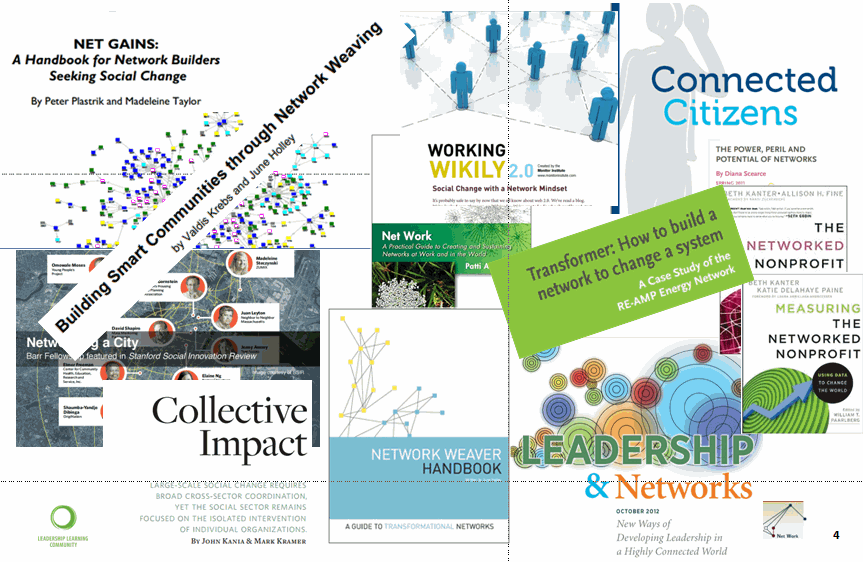
Part of what’s been interesting over the past years (as I was working on Net Work and thereafter) is the pick-up of interest in all things networks and nonprofits. I use this graphic in my workshops as a way to get people to talk about what they have (or might) read:

nonprofit reading

This is certainly not exhaustive, but it’s a pretty good list. So I have published this list (with hyperlinks) as Net Work’s NonProfit Reading List.

Two recent additions to the list (one made it into the graphic, the other not yet):

The LLC’s recent publication, Leadership & Networks (October 2012) by Claire Reinelt and Deborah Meehan. I am a contributing co-author on this paper, along with some great collaborators. The report is intended for “those who run and fund leadership programs that develop and support leadership for social change.” It highlights the importance of, and ways that, leaders in social change should be more network-aware and ways that programs can bring network literacy into their work.

I’ve also added an as-yet unpublished paper developed by Heather Creech and colleagues for IISD (especial thanks to co-author Michelle Laurie, for sharing this). I’ve been a fan of Heather’s for some time as she has been working in the development world for many years offering insights into how networks can support sustainable development. This new publication, Performance improvement and assessment of collaboration: starting points for networks and communities of practice provides a very good breakdown of types of communities of practice and suggestions for ways to measure value created by each.

Which brings me back to the topic of the webinar: it is important to understand not just how network analysis can support nonprofits in designing and assessing networks and measuring the impact of the network, but also to understand the limitations. It’s a topic of active inquiry for me — having been so immersed in SNA/ONA for so long, I am finding that it is important to be able to understand how network maps and metrics can be indicators of outcome. That’s the new net work.

TwitterFacebookGoogle BookmarksDiigoStumbleUponTumblrDeliciousShare

Archive

April 18, 2012 by Patti

New ONA Resources

This past week brought a few nodes in the interconnected map of resources (articles, papers, blogs) related to organizational network analysis (ONA).

Maya Townsend (@mayapar), Partnering Resources, has begun to blog on Change, Talent, Strategy, and Collaboration. Two of her first posts reveal how intimately she combines her expertise in ONA with her organizational development and strategic consulting expertise. One, The Most Important Positions in Your Company, provides a nice summary of three key roles in networks: hubs, gatekeepers, and pulse takers. The post links to a short white paper that expand on the topic. If you are interested in networks and organizational development, you’ll find a number of gems on Maya’s site, as she is very generous with her tools, exercises, and cases. (She was a great partner to me in a NetWorkShop I conducted for the Boston Facilitator’s Roundtable last December.)

Meanwhile, over at Activate Networks‘ blog (written by Steve Wardell) references a good article from People and Strategy last year on organizational network analysis. Authors Dan Novak, Mark Rennaker, and Paulette Turner set the stage nicely for talking about the need for ONA as follows:

Using structure to articulate the intent of an organization creates a challenge for leaders because it creates a perception of stability…However in knowledge intensive organizations, people and information need to be brought together in adaptable and flexible ways.

They present five brief case studies focused on culture change in silo’d organizations. In the concluding case study, the COO offered after-action insights, including this echo of the above:

Leaders may expect a neat and clean [organizational] design, but complex, networked realities may appear messy.

I always like a good ONA read. Keeps the juices flowing. Other flows in progress:

  • My Optimice colleagues Cai Kjaer, Laurie Lock Lee and I have just completed module 2 of 3 in our first running of the ONA Online Practitioner Course. We complete Module 3 next week when Marc Smith takes the student cohort into NodeXL territory. It’s not too late to sign up for the U.S. course that runs April 25 – May 22, with the interactive sessions May 8, May 15, and May 22.
  • The aforementioned Activate Networks is hosting an ONA Summit in Cambridge, MA on May 15. Keynoters include Activate advisory board members and ONA/SNA “heavies” Rob Cross, Nicholas Christakis, James Fowler.

And just to boggle my brain a bit, I’m attending the Collective Intelligence symposium at M.I.T. tomorrow and Friday. I hope to tweet from there (my twittering is a bit rusty, but I can still count to 140.)

TwitterFacebookGoogle BookmarksDiigoStumbleUponTumblrDeliciousShare

Archive

April 4, 2012 by Patti

Network Tensions

I was reminded recently during a meeting with a client about the importance of both distinguishing and acknowledging the tensions inherent in intentional networks. The case in point: a very high-powered network of senior leaders in the nonprofit arena who had been carefully selected to be part of a facilitated network. The funder of this network supported network members by providing them sabbaticals; planning and facilitating shared learning experiences outside their geographic area; and giving them opportunities to meet, identify shared goals and possible areas for collaboration; and fostering their visibility to the wider nonprofit and political communities.

The funder did not set specific goals for the network. That is, there was nothing that they were expected to work on as a common effort. The intention was purely to provide a container that bounded the network and to stimulate the network in various ways to enable collaborative opportunities to emerge. And they did. Still, some people continued to question the “why” of this network. What were they supposed to do, exactly?

This tension, I noted, is one of the primary ones I exposed in Net Work: “Outcome v s. Discovery.” Tensions, I wrote, “are present all the time; both leaders and members of a network should be aware of how these tensions impact the health of a network. All networks will shift along these lines of tension as they respond to changes in the environment, changes in the demographics of their members, and changes in purpose, structure, and style.”


In one of those delightful moments of serendipity, I very shortly thereafter received via email from Andrew Rixon the following cartoon:

(Cartoonist: Simon Kneebone)

It’s always nice to hear that Net Work is being used, and useful and especially gladdening to see depictions such as this one.  Thanks, Andrew!

TwitterFacebookGoogle BookmarksDiigoStumbleUponTumblrDeliciousShare

Archive

September 25, 2011 by Patti

Roles for Net Work


It’s always a rich pleasure to hear June Holley talk about network weaving. A few weeks ago, she talked about Network Weaving in the Leadership Learning Community’s ongoing seminar series.

In her talk, she outlined four key roles for network weavers and the primary activities for each.

Connector
  • Reach out to be more inclusive
  • Helping people find resources
  • Connecting people with common interests
Network facilitator
  • Coordinate working groups
  • Facilitate meetings
  • Help set up the structure of the network
Project Leader/Coordinator
  • Help people find others interested in the same things
  • Help people work together on projects
  • Help people keep organized
Network Guardian
  • Help set up good communication systems and resources
  • Set up training & support for network weavers
  • Make sure time is set aside for reflection

It’s not a stretch to think about these as progressive roles. In a network, everyone can (and should) be a connector. What’s important is to articulate it and be conscious of it. As June also says, the “Number one job” of network weavers is to help more people become weavers. And we can all do that. Moving along the progression, each role requires more skill, more experience, more thoughtfulness. And investment on the part of the stakeholders and funders of an intentional network. Fortunately for the growing number of nonprofits beginning to invest in networks and in network weavers/facilitators/guardians, June’s Network Weaver Handbook is close to completion and available for pre-ordering. I was privileged to get a peek at earlier versions, and it’s an amazing set of resources for planning  and running network weaving events, working with people to help them understand their current and needed skills, and so on.

Slides and a list of resources from this talk are available on the LLC’s Network Weaving Page. This includes the “Network Weavers Role Checklist,” so you can test yourself against the roles listed above.

(The next webinar, October 10, features another of my favorite network facilitators, Nancy White: Communities, Networks and Engagement: Finding a Place for Action. Nancy will talk about building online spaces for networks, a topic that is also a current passion of mine. Look for another blog post soon.)

TwitterFacebookGoogle BookmarksDiigoStumbleUponTumblrDeliciousShare

Archive

July 7, 2011 by Patti

Net Work Investment

Since my book came out four years ago, I have been increasingly connecting with groups in the nonprofit sector, consulting with nonprofits, and trying to navigate the differences between enterprises and nonprofits. I have been saying, working from my gut feel, that nonprofits somehow have been sooner to “get it” about networks. There is now emerging a good body of case studies and examples of how intentional, actively supported — and funded — network building within the nonprofit space achieves remarkable results.

A recent webinar sponsored by Grantmakers for Effective Organizations (GEO), “What is the role of Networks in creating scale?” highlighted  the work and thinking that is showing results (and is part of the ongoing learning dialogue). The panel for the webinar,  included Diana Scearce, of the Monitor Institute (co-author of Working Wikily and more recently, author of the awesome “Connected Citizens: The Power, Peril and Potential of Networks“); Roberto Cremonini of Cremonini Consulting Network (who led knowledge management and networking activities at the Barr Foundation in Boston for seven years); and Gayle Williams, Executive Director of the Mary Reynolds Babcock foundation, which is focused on alleviating poverty in the southern U.S.  Nancy Murphy, from GEO, facilitated the panel discussion and kept the remote audience engaged and interacting.

Diana set the stage by providing a framework for network thinking and development, an approach that blends traditional mechanisms for supporting social change initiatives with network-minded mechanisms:


Foundations like the Mary Reynolds Babcock Foundation and the Barr Foundation have been using the networked mindset, and these approaches, effectively, and are working through the challenges of working with multiple stakeholders and learning how to put structures in place that support networked action — and learning — that require giving up on linear thinking and working organically.

Roberto gave a terrific example of how the Barr Foundation managed its funding for Boston youth sports programs by showing, side-by-side, what Barr could accomplish using a traditional approach versus what it could (and did!) accomplish using networked thinking:

Both practitioners emphasized the emergent role of weaver, or facilitator, or “network officer” (as described in the linked document by the Mary Reynolds Babcock Foundation, a good and detailed description of the nitty-gritty of the work required); the need to work with the entire ecosystem; and the importance of understanding accountability.   The RE-AMP Energy Network case study provides a good example of building a network by starting with a systemic analysis of the ecosystem and the use of a skilled network facilitator.

A key audience question was, “How do you measure the success of the network?” Gayle Williams talked about the network that MRBF is funding to push tax policy legislation in Alabama. I liked her answer a lot: you can look at the results, actual changes in the tax policy, but also you need to be sure that the network is always asking the questions, “who else needs to be involved?”  How are the relationships? How easy is it for people to come into the network?” The speakers all agreed that organizational/social network analysis is playing a key role in helping people “see” their networks and understand how to improve connections.

This excellent webinar is available for replay at: http://www.youtube.com/watch?v=CYudIfermUg

I have always said (and written) that a network produces value based on its purpose, and also provides value to those in it. One of the cases mentioned in this webinar is one I have some personal connections to, the Barr Fellows program which is also supported by the Barr Foundation and facilitated by colleagues at IISC. My friend and colleague Claire Reinelt recently published a case study on this program, which weaves cohorts of nonprofit leaders in the Boston area. Fellows are given 3-month sabbaticals, a shared learning experience somewhere in the global south, and the opportunity to develop “authentic, honest, and accountable relationships with each other.”  It’s not hard to imagine the value to the city of Boston of such inter-connectivity across the Fellows, nor the amazing fund of social capital that each of the Fellows has to draw on.

This work, this investment, in networks and communities is one of the areas of commonality between what we are seeing in Enterprise 2.0 and the nonprofit world. In E2.0, the focus is on communities (see my comments on Rachel Happe‘s talk at the E2.0 conference — and her talk itself, The Strategic Imperative of Communities) but I refuse to get into the semantic arguments about the differences between networks and communities. For the purposes of declaring that work gets gone, goals get accomplished, and visions achieved best through connected sets of people, it doesn’t matter. Nor does it matter what we call them when there are opportunities to learn. The big learning so far this week: E2.0 and nonprofits agree. If you want to work successfully, you have to invest in networks. Community managers/facilitators/network officers/network weavers. Whatever you call them, you need them, and you need to invest in them.

TwitterFacebookGoogle BookmarksDiigoStumbleUponTumblrDeliciousShare

Search

Archives

Communities and Networks

Communities and Networks Connection

Publications

Now available from Amazon.com and other online booksellers:

Posts this Month

May 2013
M T W T F S S
« Jan    
 12345
6789101112
13141516171819
20212223242526
2728293031  

Categories

  • adoption
  • blogging
  • brain
  • causes
  • collaboration
  • collective intelligence
  • communities
  • complexity
  • culture
  • definitions
  • e2conf
  • Enterprise 2.0
  • future-of-work
  • generations
  • health
  • innovation
  • KMWorld
  • knowledge management
  • language
  • leadership
  • mindsets
  • net work
  • networks
  • nonprofits
  • ONA
  • people
  • PKM
  • relationship
  • SNA
  • social business
  • social learning
  • social media
  • social network analysis
  • software
  • speech acts
  • trust
  • Uncategorized
  • value networks
  • women

RSS Rss Feed

  • Networks and NonProfits
  • Integrating Network Analysis into a Social Media/Collaboration Project
  • New ONA Resources

All content © 2013 by Patti Anklam. Base by Graph Paper Press.